
The importance of wheel balancing and alignment
7th April 2025
Many times, I have sat behind the steering wheel of a car and set off down the road, only to almost immediately sense something was off.
Vagueness in the steering, despite there being no obvious knocks or apparent free play. Constant correction of the steering due to the car ‘wandering’ from its line of travel. A vibration felt through the steering wheel, perhaps even through the whole car. Any of these issues, individually or in combination, may be attributed to unbalanced or misaligned wheels.
The alignment of a vehicle’s wheels, commonly known as ‘tracking’, may be heard in a garage setting with the familiar phrase ‘you want your tracking set, mate’, meaning that the person you may have consulted about your car’s foibles has diagnosed a case of wheel misalignment.
Misalignment can occur simply through general wear and tear, or as a result of hitting a kerb or severe pothole, or following a collision. The damage is more often than not invisible to the naked eye, that is until the aforementioned symptoms begin to appear. But there are also visual clues that all is not well in the alignment and balancing departments.
INSPECT YOUR CAR’S TYRES
We all should inspect our car’s tyres for any signs of wear and deterioration on at least a weekly basis, but the unusual wear patterns caused by misalignment and imbalance may be missed, or misunderstood without a ‘heads-up’ of what to look out for.
Toe In or Toe Out
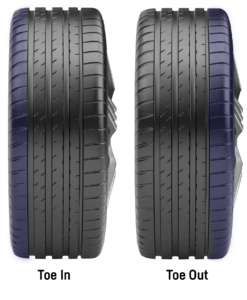
A telltale sign of wheel misalignment is excessive wear to the outer or inner edges of the tread area of the tyres. This wear may be attributed to excessive ‘toeing in’ or ‘toeing out’ misalignment of the vehicle’s wheels and can affect a single axle or even, in some severe cases, both.
Initial signs of wear may include a ‘feathering’ effect to the tread of the tyre, where the inner or outer edge of each vertical tread piece displays a difference in height to its adjacent neighbour.
This wear can sometimes be subtle enough to be missed if it only affects a narrow bandwidth of a tyre, allowing this area in particular to wear to a dangerous degree, even to the point of exposing the internal steel reinforcement layers.
It is thus wise not only to make a visual check, but also to feel the tyre, taking precautions not to cause a puncture wound to the hand by wearing leather faced or similar gloves.
Single or Isolated Wear Patches

Single or isolated wear patches on a tyre are a symptom of wheel imbalance, where one area of a wheel has a different weight or mass, thus causing an isolated force onto areas of the tyre. This type of defect becomes more apparent to the driver as wear increases, with vibration being felt as the tyre wears excessively, eventually producing, in effect, ‘flat spots’.
Uneven Wear Around the Whole of the Tyre
Not necessarily associated with wheel alignment or imbalances, but included here for completeness, is the wear associated with worn shock absorbers (dampers). When a shock absorber does its job properly, it keeps the tyre in contact with the road by preventing the wheel from ‘bouncing’ (oscillating) up and down under the influence of the oscillation of its suspension spring.
As this oscillation is largely due to road surface unevenness, the wear also tends toward displaying an uneven pattern. However, shock absorber wear combined with wheel imbalance may not only allow even greater tyre wear, but due to the fact that the tyre will not be in constant contact with the road surface, adds to a likelihood for the vehicle to be directionally uncontrollable.
Wear due to Excessive Camber

Tyre wear due to excessive ‘camber’ – the vertical tilting in or tilting out of the wheel relative to the vehicle’s structure, displays what at first might be mistaken for the same wear pattern produced by the toeing in or out of the wheel. However, in the case of excessive camber, there is less likelihood of the ‘feathering’ of the tyre’s tread than in the event of ‘toe’ abnormalities, although a combination of these two faults could lead to a casual misdiagnosis.
What to Do if You Suspect Your Car Has Problems
If you ‘feel’ any of these symptoms when driving, or suspect any of these wear patterns when inspecting your car’s tyres, head straight to your local tyre and wheel alignment specialist for advice, and to book your car in for a thorough check.
If any adjustment is required, the specialist should also look for component wear and/or damage, which may be the cause of the vehicle’s problems. Rectification of any defects might well positively transform the driving experience of your car, and most importantly, will help to keep you, your loved ones, and all those around you much safer on the roads.